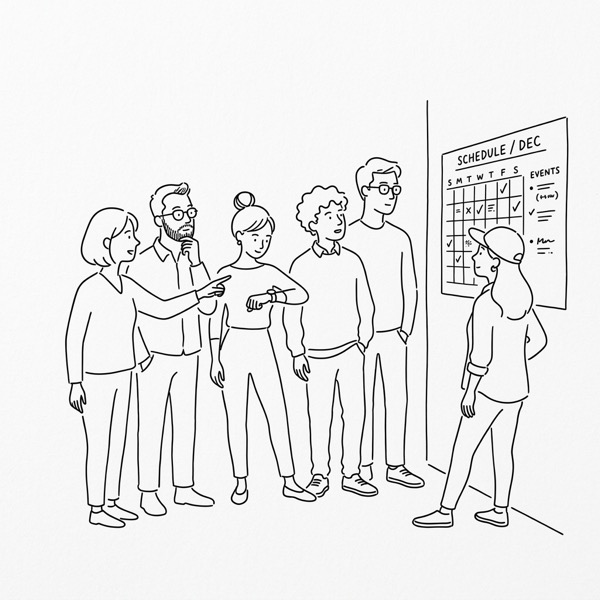
Priority chaos usually starts after planning, not before it
Many small teams think their priority problem is that they have not planned enough.
So they create another board, another planning document, another kickoff, or another channel where work can be re-sorted in real time.
But the real problem usually appears after the priorities are chosen. The team does not protect active work from new input. A late request arrives. A leader gets nervous. A customer conversation produces three new ideas. Suddenly the week is being renegotiated again.
When that happens every few days, the team never gets enough uninterrupted time to finish anything substantial.
Stable priorities come from defending active work
Priority stability is not about being rigid. It is about giving the current commitments enough time to produce a result.
Small teams especially need this because their advantage is low coordination cost. If three people keep re-sorting the same five tasks, the team burns its edge on internal churn instead of finished work. That is the same principle behind Why Small Teams Still Win: small teams win when they stay clear enough to move.
Better tools make reshuffling look harmless
Modern work tools make reprioritization feel cheap.
Project boards can be reordered instantly. Chat makes every request feel present. AI can turn a half-formed thought into a plausible new plan in minutes. So the team starts changing direction with almost no friction at the moment the idea appears.
The friction does not disappear. It simply moves downstream into lost focus, reset costs, and half-finished work. That is why A Simple Weekly Operating Rhythm for a 5-Person Team matters. The week needs a place where priorities can move, so they do not move everywhere.
Four rules that keep the week from being renegotiated daily
1. Choose fewer active priorities than feels comfortable
Most teams do not have too few priorities. They have too many active ones.
Keep the active list small enough that everyone can name it from memory. For many small teams, that means three to five active priorities, not ten. Anything else belongs in the backlog, the intake list, or next week's review.
2. Give new work an intake lane instead of an active slot
New requests should have a place to go that is not "we are doing this now."
That lane might be a simple list called "review next," a document section for incoming work, or a short memo that gets discussed at the next planning point. The important thing is that new input has a home without automatically displacing current commitments.
3. Use one review point for priority changes
If priorities can change at any time, they eventually will.
Choose one point in the week when active work can be reshuffled. Outside that point, a change should clear a higher bar. In many teams, that bar should look a lot like the urgent threshold in How to Define Urgent So Everything Stops Being Urgent.
4. Make the switching cost visible in writing
When someone wants to insert a new priority, they should also name what loses time, attention, or scope as a result.
That can be as simple as one sentence:
"If we move this in now, priority B slips to next week."
This matters because priorities feel unstable when teams keep adding without subtracting. Writing the tradeoff forces the team to see that a change is not free.
One rule for midweek priority changes
If new work cannot clearly beat an active priority in writing, it waits for the next review point.
A weekly priority protection checklist
Use this checklist at the start and midpoint of the week:
- Are there only 3 to 5 truly active priorities?
- Does each active priority have one owner and one visible next step?
- Is new input going into an intake lane instead of the active list?
- Is there one known review point for changing priorities?
- If something new came in, what moved out or slipped?
If the answer to the last question is "nothing," the team is probably adding work without admitting it.
How priority stability quietly breaks
One failure mode is treating every customer request as equally immediate. Important requests still need order. They do not all deserve instant displacement.
Another is leadership override. If leaders can casually reshuffle the week in chat, the official process becomes theater.
The last failure mode is confusing visibility with commitment. A task appearing on a board does not mean it is active now. Teams need a visible difference between "captured" and "committed."
Three calm days are enough to create momentum
A small team does not need priorities that stay fixed forever. It needs priorities that stay fixed long enough to finish something meaningful.
Protect the active list, give new work a waiting place, and make tradeoffs explicit. Once the team can hold priorities steady for even a few days, execution starts to feel real again.